
 October 23, 2011

The Writing on the Wall
I went to my first prostate cancer gathering four years ago, in Portland, Oregon, when I was fresh off surgery and unexpected news from pathology was still ringing in my ears: cancer in two lymph nodes. Entering the building, registering, and being handed my conference materials — I felt like a draftee reporting for induction into an army of conscripts.
That gathering was the 7th Annual Pacific Northwest Prostate Cancer Conference, and yesterday was the 11th, the fifth in my attendance streak. With time, I’ve come to value these get-togethers as important connections to my cancer community, as well as recurrent reminders that I am not alone. I’m always energized by my fellow cancerians, knowing the challenges and the struggles all face and seeing the strength and courage they display.
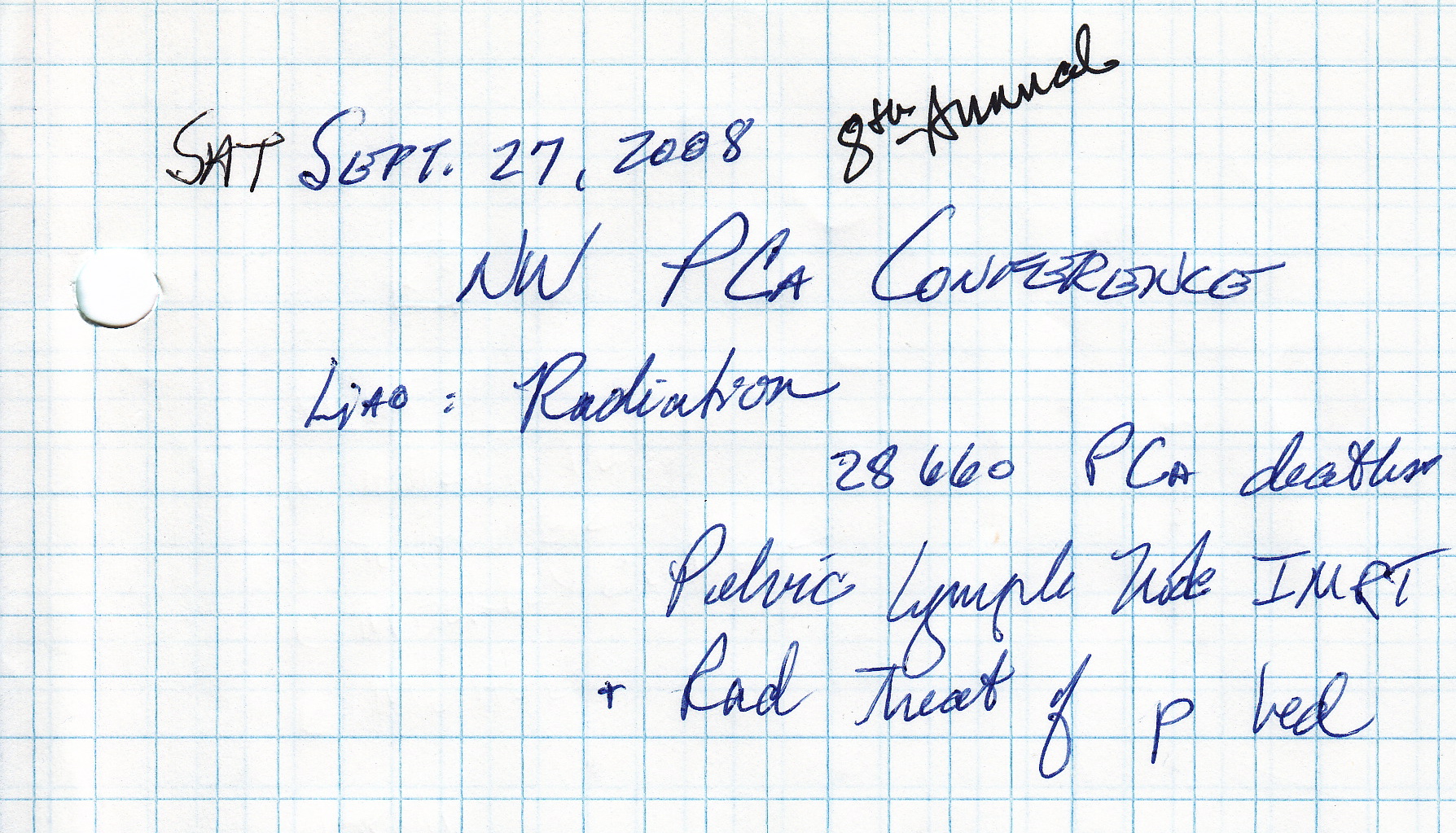
I must admit, however, that I’ve sometimes felt that much of the discussion was intended for others, not me. At the 8th conference, for example, on Sep 27, 2008, I scratched this fragment in my notebook: “Pelvic Lymph Node IMRT + Rad treat of p bed.” I just didn’t pay enough attention to take further notes of elaboration, what it all meant and why the topic was in play. It just didn’t apply to me and never would.
Today, of course, that’s exactly where my cancer journey has taken me, to that prescient scrawl — that writing on the wall — and I’m now 24 treatments into Intensity Modulated Radiation Therapy of the pelvic lymph nodes and prostate bed.
Importantly, these gatherings also provide key updates on advances in the treatment of prostate cancer. In the past 18 months, for example, there’ve been four new life-extending drugs brought to market for men with metastatic disease that’s resistant to traditional therapies. And more are on the way. What is probably next, Radium 223, is on a fast-track for approval, if all goes well, in late 2012, early 2013.
But can the track ever be fast enough when a disease causes 34,000 deaths a year?
“Why wait for tests, people gonna die in a year?” one frustrated guy asked, somewhat angrily, at the 2008 conference. He was specifically anxious for abiraterone, a drug for well advanced, metastatic prostate cancer that the FDA eventually did approve…two and one-half years later.
That man, that guy in the back row urgently hoping for help — I can only wonder whether he was still alive when hope finally became help.



 My First Cancer
What’s wrong with me(n)?
Until July 24
Since poking my head up into the cancer blogosphere, I’ve been looking about a bit, reading blog posts here, there and everywhere. It’s been a grim revelation to see and hear the emotional pain that can accompany cancer.
And, I’m sorry to report, how often men are the wellspring of much of that pain.
No, I’m not saying all men. There are uncountable numbers of men out there who are loving and supportive caregivers all. You can read that in the blogosphere, too: In toting up her cancer blessings, Nicole, larynx cancer, thanked from her heart, Don, my husband — industrial strength, flawless diamond support and escort service for all my treatment needs. My indefatigable rock, he always finds a way to time his jokes when I’m not trying to swallow.
But there is a Guy Thing out there, make no mistake, and I did not set out to find it. I was merely skimming posts, literally just looking out the window while on my cancer journey. And this is what I saw:
A woman with breast cancer, metastasis to her lungs: Don’t know how I’m going to find the strength to do everything I need to do to get rid of this cancer & still work full time which is what my husband seems to think I need to do 😦
A woman with ovarian cancer, in her 40s: Facing a second recurrence, and I am terrified right now. My mother died 18 months ago, after an 11-month bout with OC. Then my father passed away nine months ago of heart failure. So I already had grief and stress in my life, plus my main source of comfort and support is gone. My former husband was not the best of support, but our marriage ended five months before my mother died. So I am crushed at the daunting prospect of going through treatment again.
Another woman with breast cancer: I’m so depressed. I don’t know if it’s my cancer, my new fake breasts, my nasty husband or just life…. I hate my new nipple-less fake breasts, they don’t feel like a part of me and my marriage has fallen apart because my husband refuses to be a part of my cancer afterlife. He won’t touch me, he hates me and wants the old me back.
A woman with stage 4 kidney cancer: My relationship fell apart because of cancer. He couldn’t come to terms with it, and I got tired of the guilt of focussing on my self.
And then I recalled the lady on a Survivor Panel, June 26, 2010, “Moving Beyond Cancer to Wellness” at the Fred Hutchinson Cancer Research Center here in Seattle. She had been diagnosed with lymphoma, I believe, and the prognosis had not been good.
“My husband came to me one day and said, ‘I’ll take care of the kids, but I can’t handle your cancer.’” She then explained that there was no way she was going to put her husband, her children and herself through the stresses and pains of divorce only to…die. However justifiable a divorce might have been, she just wasn’t going to cause a family wreck and then leave the scene. (What a classy lady, I thought then, and I think so still.)
She finished her remarks about cancer’s impact on families and then came the Q and A. Someone in the audience finally asked about the elephant in the room: “What became of your marriage?”
“When I realized I was going to live,” she answered, “we separated.”