Archive | Prostate Cancer RSS feed for this section

The New Normal

Havana Teacher

Havana Classroom, 2010

Today marked three months since my completion of salvage radiation. “Has it been three months already?” they asked me at the check-in desk in Radiation Oncology at the Seattle Cancer Care Alliance.  I was reporting for a routine, follow-up visit with my radiation oncologist to attend to any lingering side effects since radiation’s end (none to report, knock on wood). It was brief, friendly and, in retrospect, almost remarkable for its lack of any mention of cancer. In short order, I was on my way.

It wasn’t until later, at Sea-Tac International Airport, that cancer raised its head.

I’m on my way back to Cuba, and I had given this absolutely no thought until, there I was, at the tail of the security line, gazing into a queue of passengers being herded to the whole-body security scanners.

I’ve tried to follow both the science and the scandal surrounding these devices, and while, at the bottom line of the science, there may be inconclusiveness about their safety, I reacted very simply: more radiation. And I’ve now had a lifetime’s worth. An X-ray for medical purposes, I understand and accept, and even for a dental exam, I’m fine – but for this? The two words reverberated: more radiation.

A touch of urgency set in. My failure to think this through beforehand was now forcing an impulsive decision: Can I refuse? How? And what’s my alternative? What exactly had I read in the news? And on the blogs — what had my fellow cancerians warned about these scanners? Why were they banned in Europe? Why hadn’t I thought of this?

Time was up. Time to declare my intentions or proceed to more radiation. No! I told myself, and then, with conviction to the TSA officer: “I need a non-radiation alternative.” I was cautioned about the sole alternative, a physical pat down. “Fine.”

“Step over there.” And over there, starting at my collar, blue latex hands began their inquisitive journey, down my torso, front and back, around and inside my waistband, and finally down my thighs, knees, calves, shins, to my very socks, the blue hands hijacking my every sense: I remember seeing and hearing nothing of the airport around me. The TSA officer was polite, official, thorough. And I was done.

Not yet. The officer’s blue latex gloves now needed to be checked for any explosive residue gleaned from my clothing. I stood alone, my shoeless feet aligned on a yellow +. Curious travelers passed, their eyes aiming unspoken questions at me. They hurried on.

And this, I thought, is my new normal.

A Stalking, Circling Menace

Predator

I’m on my own now.

On Oct 17, I had my final three-month injection of hormone suppressant. So any day now, the side effects (hot flashes, chemo-brain and fatigue) should start ebbing, and testosterone should start flooding. The problem is, testosterone fuels the growth of prostate cancer, so now also begins the big wait-and-see, the medical equivalent of Neighborhood Watch, an anxious lookout for something to go wrong: recurrence.

A diagnosis of cancer is an ambush. Recurrence is predation in the night, a stalking, circling menace, unseen but sensed and feared — yet not fully realized until the pounce.

I’ve yet to meet a cancer survivor who doesn’t have at least a farthing of fear of recurrence. We all sense this menace, and it changes us and how we approach the very notion of time. We condition our present with a parenthetical (for now), and we hedge our future with a conditional “if all goes well.” We don’t talk of being “cured,” just that there’s “no evidence of disease.” Some survivors even animate recurrence: “the bear in the back room,” my friend Sandi calls it, waiting to break out.

These are the altars of language we kneel before to pay homage to Truth: With one routine test, our cancer circumstance can abruptly change — and with it our lives.

For prostate cancer survivors like me, it’s the PSA test that brings a slowly ratcheting anxiety, but all strains of cancer have follow-up tests or scans of their own, and all cancerians know the accompanying tension: the dread that the results will — this time — bring that feared change in circumstance. I finished my first round of hormone therapy in Oct 2009 and for nine fleeting months tested negative: no evidence of disease. But on July 12, 2010, with just five words, my cancer circumstance was abruptly changed. “Your PSA is not undetectable,” they said. PSA, a blood-marker of prostate cancer, had returned.

The predator had pounced.

Recurrence shook me. All the important things I’d been diligent about, all my strategies for pushing back, now seemed trivial, almost wasted, and I was reminded, one more time, that cancer is a disease and a metaphor for loss of control. It hadn’t mattered what I’d done. The cancer that had metastasized to my lymph nodes prior to surgery — even before diagnosis? — had endured.

A small voice within whispered, “You’re in trouble.” This was proving to be a more difficult contest with cancer than I’d foreseen, hoped or assumed. I doubled down on diet, exercise and nutrition, and I began seeing a naturopathic oncologist. I also began paying closer attention to new drugs in testing and coming to market: Which one, I muse, could someday become a vital part of my life?

Eventually, recurrence led to my recent round of salvage radiation, a one-off attempt to see if, finally, we could root out — even just suppress for a few years — the cancer that’s eluded all prior attempts. On Jan 23, I’ll have my first quarterly PSA check since radiation and, after that, quarterly tests for as far as the eye can wait-and-see: April…July…October…January. Lather, rinse, repeat.

But today, no pills, no injections, no radiation — I’m off treatment and on my own (for now).


Boys of Summer

Reflections: Honoring Fred Hutchinson, Manager, Cincinnati Reds

It may be the sole summer of my youth that I recall with any real clarity: the summer of ’61, that listless season after high school graduation, when Al Mosher, Bill Salzer and I spent many humid nights at Crosley Field, watching the Cincinnati Reds, under manager Fred Hutchinson, win their way to a National League pennant and a shot at the Yankees in the World Series.

The Reds, alas, would lose the Series; Al, Bill and I would choose separate life paths but not stray apart. There would be Al’s wedding, and, later, a son. There’d be clueless weekend nights with Bill over Stroh’s beer at Shipley’s, where he’d lament statistics class, and I’d talk about my work at WKRC-TV.

And then it all fell apart.

On Dec. 15, 1967, 44 years ago today, Al stepped on a “friendly” land mine in Vietnam; his widow, Sharon, called me in New York with the news, and I went down to Washington for Al’s burial at Arlington. Bill, in the Army and stationed in Okinawa, escorted Al’s body home for the funeral. The three of us were together once more, together one final time.

I never saw Bill alive again. Two years later, a captain at Ft. Hayes, he was murdered by a soldier under his command.

Two young lives brought to an end in their mid-20s, and 40-, 50-plus years of life stolen from each, years they never had the opportunity to experience, to savor and to hold dear. I often tell myself that Bill and Al would love to be my age and have my Stage 4 prostate cancer — and that puts my cancer, and my life, in perspective; keeps my head screwed on straight; and reminds me of all the blessings of life, whatever the bumps.

Today, just to close this circle, my oncologist, besides treating me in the clinic, conducts prostate cancer research — at the Fred Hutchinson Cancer Research Center here in Seattle.

And, yes, it’s named for the manager of those Cincinnati Reds, that summer of ‘61.

The Radiation Arrow

Team SCCA: Patient with radiation therapists (L to R) Tony, Jason, Lorena

My 36 radiation treatments ended today, and we marked the occasion at Seattle Cancer Care Alliance with thank-yous, good-lucks, handshakes, a hug and a team photo of patient and therapists. In the cheer of it all, I felt the sadness of separation. I was the teammate who got traded. They stay together, and I move on. I’ll miss them.

Later, there was champagne at home (thank you, Craig). It was nothing, really, you’d call a big celebration, just a marking of the occasion with a toast and some of France’s best: one more cancer therapy, now completed.

Radiation seemed to go well — if you ignore the fact that there’s no way of knowing (yet) whether it “worked.” I asked how/when we’ll know if the radiation did me any good. The answer: When

  • I’m done with hormone suppression (in January);
  • my testosterone has returned to normal (about July);
  • and I’ve no detectable PSA,

then it worked!

Translation: not any time soon.

In fact, I hope it takes years — decades, even — to know. For the longer I go without PSA, the likelier the radiation worked its magic. I don’t know if there’s an end point where someone will announce, “It worked!” It will more likely be just three months at a time as I pinball from one PSA test to the next. We should, though, get some idea over the next few years whether my PSA, and thus my cancer, are ever to come back.

(Because I’ll be making increasingly frequent, and increasingly important, references to PSA in these posts, I’ve created a petite primer on PSA and where it fits in my health care — the PSA & Me link, above, if you’re inclined).

I do remind myself that salvage radiation was never held out to me as a slam-dunk “cure.” I knew, and I know, viscerally and intellectually, that radiation was never a solid certainty — nor was it a hollow hope. It was somewhere in the scheme of possibility, but, like whack-a-mole, the greater probability is that my cancer will pop up again.

In short, I never saw radiation as the silver bullet. It was always an uncertain arrow in the oncologic quiver.

And it has now been spent.

I shot an arrow into the air;

It fell to earth I know not where.

–Longfellow

The Writing on the Wall

The Writing on the Wall

The Writing on the Wall

I went to my first prostate cancer gathering four years ago, in Portland, Oregon, when I was fresh off surgery and unexpected news from pathology was still ringing in my ears: cancer in two lymph nodes. Entering the building, registering, and being handed my conference materials — I felt like a draftee reporting for induction into an army of conscripts.

That gathering was the 7th Annual Pacific Northwest Prostate Cancer Conference, and yesterday was the 11th, the fifth in my attendance streak. With time, I’ve come to value these get-togethers as important connections to my cancer community, as well as recurrent reminders that I am not alone. I’m always energized by my fellow cancerians, knowing the challenges and the struggles all face and seeing the strength and courage they display.

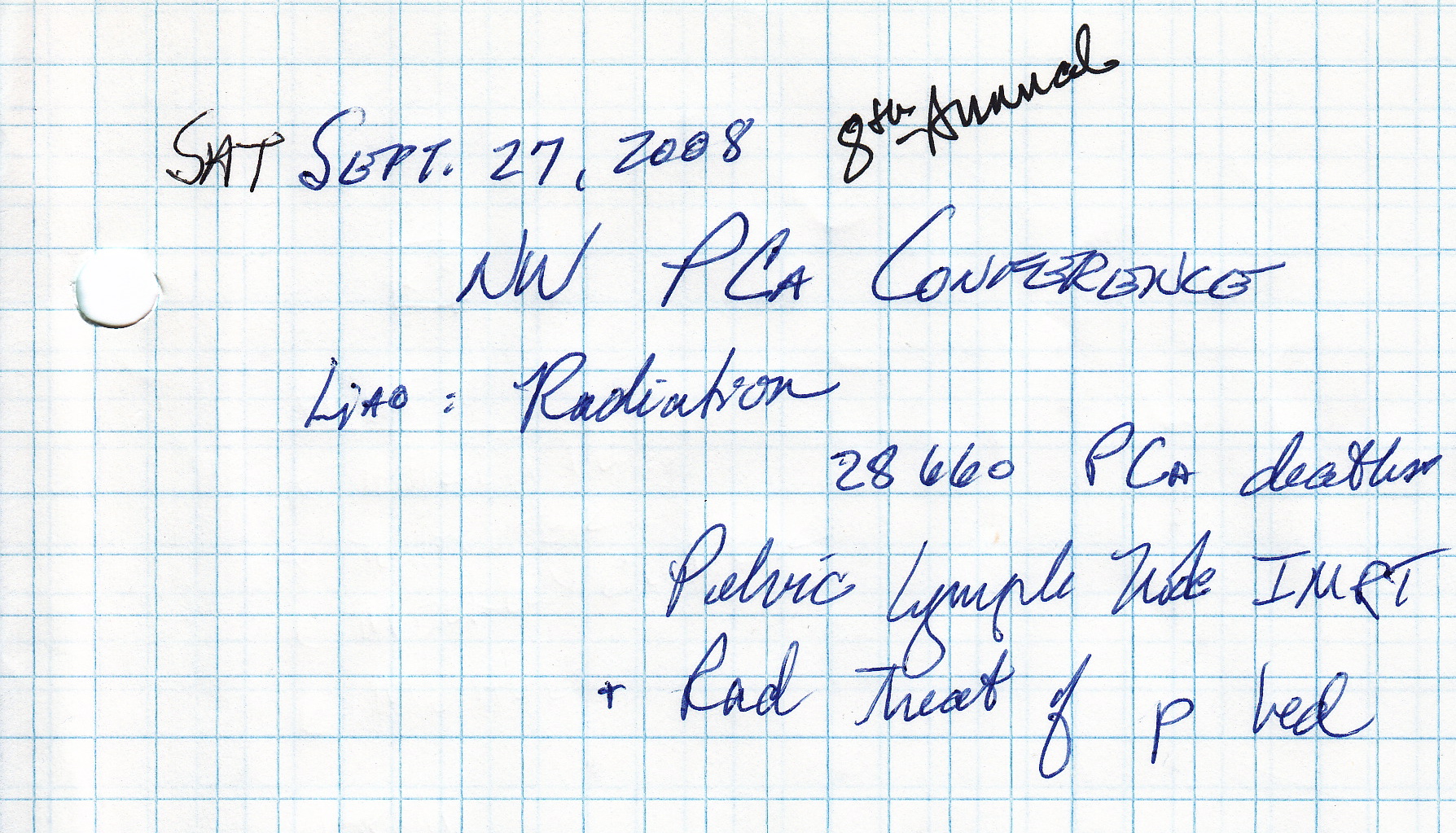
I must admit, however, that I’ve sometimes felt that much of the discussion was intended for others, not me. At the 8th conference, for example, on Sep 27, 2008, I scratched this fragment in my notebook: “Pelvic Lymph Node IMRT + Rad treat of p bed.” I just didn’t pay enough attention to take further notes of elaboration, what it all meant and why the topic was in play. It just didn’t apply to me and never would.

Today, of course, that’s exactly where my cancer journey has taken me, to that prescient scrawl — that writing on the wall — and I’m now 24 treatments into Intensity Modulated Radiation Therapy of the pelvic lymph nodes and prostate bed.

Importantly, these gatherings also provide key updates on advances in the treatment of prostate cancer. In the past 18 months, for example, there’ve been four new life-extending drugs brought to market for men with metastatic disease that’s resistant to traditional therapies. And more are on the way. What is probably next, Radium 223, is on a fast-track for approval, if all goes well, in late 2012, early 2013.

But can the track ever be fast enough when a disease causes 34,000 deaths a year?

“Why wait for tests, people gonna die in a year?” one frustrated guy asked, somewhat angrily, at the 2008 conference. He was specifically anxious for abiraterone, a drug for well advanced, metastatic prostate cancer that the FDA eventually did approve…two and one-half years later.

That man, that guy in the back row urgently hoping for help — I can only wonder whether he was still alive when hope finally became help.

This Afternoon in Cancer

Oct 17 2011 Lupron injection

Lupron: Kim, mixing it up -- and getting the lumps out

A full afternoon at the Seattle Cancer Care Alliance today: the daily radiation treatment, the weekly visit with the radiation oncologist, the quarterly check-in with my oncologist.

  • PSA test results came in at “undetectable,” which you’d largely expect, given my hormone-suppression therapy. Prior reading, in July, which was pre-hormone therapy, was 0.11. So that means PSA is down.
  • Radiation treatment #20 — check that box. I’m now solidly past the halfway point on the way to 36.
  • Another Lupron injection, which, with my Casodex pills, will keep my testosterone fully suppressed for the next three months. Upside: hot flashes in winter.
  • My oncologist said today’s Lupron shot would be the last for now. I’ll see him again in January for a quarterly check-up and a PSA test — but no more Lupron and no more Casodex after that.
  • And my radiation oncologist said he’s happy, which makes me happy, too. I reported to him that the few side effects from my salvage radiation have, so far, been mild and manageable.

And what, exactly, is salvage radiation? Bob Grindeland posed the question in his comment on my prior post, and that set me off to find an answer. I realized that while it’s a term I’ve heard, read and even used, I’d never pursued a medical definition. After all, “salvage” seemed to convey so much. Maybe even too much: say, the image of saving a ship from being battered on the rocks. But since Bob asked, here goes…

The National Cancer Institute defines salvage as “treatment that is given after the cancer has not responded to other treatments” — in my case, surgery.

The dictionary definition of salvage is more in the vernacular: “the rescue of property or material from potential loss or destruction.” Like salvaging a ship from being battered on the rocks.

Or salvaging me from cancer.

In the Rearview Mirror, Two Weeks

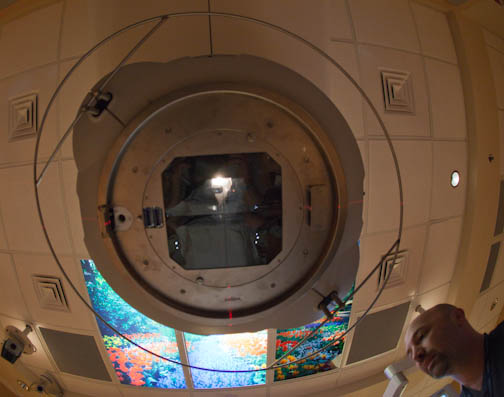
Shooting the radiation machine before it shoots me.

Today was treatment #10 (26 to go) — so two weeks of salvage radiation are now in the rearview mirror. All’s gone well, but…

It’s a bit early for side effects to set in, and exactly what they’ll be, how severe they’ll be and how long they’ll last — well, those are the uncertainties, all of them idiosyncratic to each one of us. However, they did caution me today to be prepared for some side effects: There’s no get-out-of-jail-free card.

Fatigue, though, is a given, but then, fatigue is cancer’s spectral companion and a hidden cost of its treatment.

I’ve now experienced one full cycle of the treatment protocol: Radiation every weekday afternoon followed by a rad onc appointment (on Mondays) and a blood draw (on Thursdays). The blood draw is for a complete blood count (CBC) to keep tabs on what the radiation to my pelvic bones may be doing to the marrow that makes blood cells. Thursday’s CBC proved to be fine.

This is a short post, just a reader-board update. The best news is: There’s no news.

An Uneventful Event

Radiation Treatment #1 (complete with red laser)

I had radiation treatment #1 today, with 35 more in queue each weekday afternoon through Nov 8. No side effects expected for the nonce.

It was easy and uneventful — well, uneventful to my eye. We’ll hope some little prostate cancer cells met an invisible and violent death, but that was nothing for me to see or even feel. The treatment itself involved radiation doses from nine different directions into a band around my pelvis. Ground zero was the prostate fossa, the area where my prostate resided until surgery.

“Lay still and breathe normally,” they told me as I lay on a hard table. The radiation machine circled my pelvis, and the therapists occasionally tweaked the positioning. Some kind of red laser beamed at me from the ceiling next to a sign that warned, Do Not Look at the Laser. All cut and dried, chop-chop. Except.

Except for the frisson, the palpable sensation I’d not had since surgery four years ago. You know how something can happen, and it just drives home and makes vivid the reality of a situation? Surgery drove home, italicized and put in bold my stark reality of 2007: I’ve got cancer, and that’s not good.

Same thing today at Radiation Oncology at the Seattle Cancer Care Alliance. I can’t remember whether today’s realization came while waiting for my first treatment or while talking to the guy waiting for his last; whether I was arranging the schedule for future treatments or was looking helplessly at the radiation machinery arrayed around me. But that old, familiar reality came back and drove itself home:

I’ve still got cancer, and that’s not good.