
 April 29, 2012
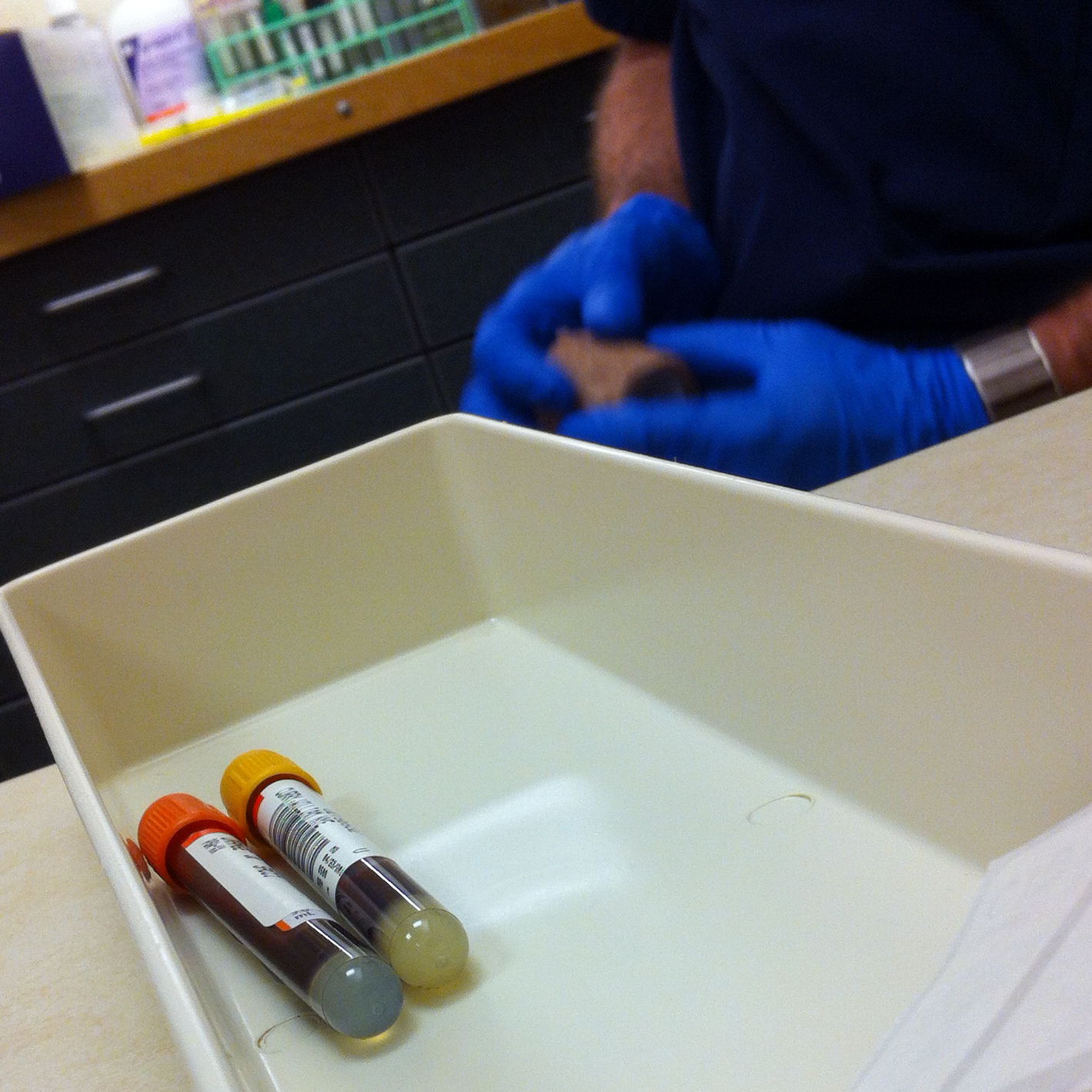
Apr 23, 2012: Blood Draw
Last Monday was my quarterly check-in with the oncologist, and I had hoped that my PSA test results would come back “undetectable” — no evidence of disease. Not so. The oncologist conditioned the results with (a totally appropriate) “if it’s real.” One data point does not a trend make, especially when this particular data point is so mercurial and the amount so scant: a barely detectable PSA level of 0.04 ng/ml.
But it’s most likely real. And that’s not good because, given where I am in my cancer journey, detectable PSA can be evidence of disease. We’ll check again in three months and go from there. Stay tuned.
Assuming it’s real, though, it seems that the odds likely prevailed, and my salvage radiation probably didn’t work.
***
I’d like to detour from my cancer journey to (sadly) note the passing of a high-school classmate and friend, Sandi Sheff Bernstein. Sandi died April 14 of non-Hodgkin lymphoma after two contests with breast cancer. When I wrote on January 17 about the fear of recurrence that occupies all cancerians (A Stalking Circling Menace), I noted that for my friend, Sandi, recurrence was “the bear in the back room,” trying to get out. Her bear, unfortunately, did break free.
Sandi was both classy and courageous. When I disclosed in March 2011 that I have Stage 4 prostate cancer, Sandi re-entered my life — almost 50 years after our high school graduation.
It was worth the wait.
“[Cancer] is a good thing, in a way,” she wisely wrote upon her re-entry into my life. “It reminds me that life is on loan to me and I should use that time in a good way. I want to be seen as a giver and not a taker. I am very fortunate, I know, to have been a survivor twice. I would love to follow your journey and commend you on how you are handling it. Sending you my prayers and good wishes, try to make the journey work for you.”
Later she would tell me: “Attitude is so important. Fight that cancer. Never give up. And when you are well again, remember all you have learned along the way.”
In addition to her comments on this blog site, Sandi and I also had a year of email exchanges about our cancers, which were, really, conversations about life. She grasped that cancer can kill you, but only you can decide to quit living.
“So back to the bear in the bedroom,” she wrote with prescience — but without fear — in what would be her last email to me. “He’ll win this round. I just don’t know when. One thing I won’t let happen is let the bear win until the final round. I can live with him, side by side, but I still plan on enjoying the life I now have with family and friends. He’ll just have to settle on being in the back bedroom until my time has come. I won’t let my attitude be affected by this. It is still my life, and he can’t claim my attitude unless I let him…”
Shalom, Sandi. Shalom.




 My First Cancer
Boys of Summer
Reflections: Honoring Fred Hutchinson, Manager, Cincinnati Reds
It may be the sole summer of my youth that I recall with any real clarity: the summer of ’61, that listless season after high school graduation, when Al Mosher, Bill Salzer and I spent many humid nights at Crosley Field, watching the Cincinnati Reds, under manager Fred Hutchinson, win their way to a National League pennant and a shot at the Yankees in the World Series.
The Reds, alas, would lose the Series; Al, Bill and I would choose separate life paths but not stray apart. There would be Al’s wedding, and, later, a son. There’d be clueless weekend nights with Bill over Stroh’s beer at Shipley’s, where he’d lament statistics class, and I’d talk about my work at WKRC-TV.
And then it all fell apart.
On Dec. 15, 1967, 44 years ago today, Al stepped on a “friendly” land mine in Vietnam; his widow, Sharon, called me in New York with the news, and I went down to Washington for Al’s burial at Arlington. Bill, in the Army and stationed in Okinawa, escorted Al’s body home for the funeral. The three of us were together once more, together one final time.
I never saw Bill alive again. Two years later, a captain at Ft. Hayes, he was murdered by a soldier under his command.
Two young lives brought to an end in their mid-20s, and 40-, 50-plus years of life stolen from each, years they never had the opportunity to experience, to savor and to hold dear. I often tell myself that Bill and Al would love to be my age and have my Stage 4 prostate cancer — and that puts my cancer, and my life, in perspective; keeps my head screwed on straight; and reminds me of all the blessings of life, whatever the bumps.
Today, just to close this circle, my oncologist, besides treating me in the clinic, conducts prostate cancer research — at the Fred Hutchinson Cancer Research Center here in Seattle.
And, yes, it’s named for the manager of those Cincinnati Reds, that summer of ‘61.