
 October 17, 2011

Lupron: Kim, mixing it up -- and getting the lumps out
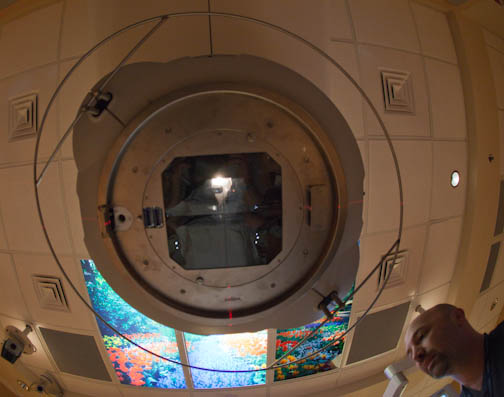
A full afternoon at the Seattle Cancer Care Alliance today: the daily radiation treatment, the weekly visit with the radiation oncologist, the quarterly check-in with my oncologist.
- PSA test results came in at “undetectable,” which you’d largely expect, given my hormone-suppression therapy. Prior reading, in July, which was pre-hormone therapy, was 0.11. So that means PSA is down.
- Radiation treatment #20 — check that box. I’m now solidly past the halfway point on the way to 36.
- Another Lupron injection, which, with my Casodex pills, will keep my testosterone fully suppressed for the next three months. Upside: hot flashes in winter.
- My oncologist said today’s Lupron shot would be the last for now. I’ll see him again in January for a quarterly check-up and a PSA test — but no more Lupron and no more Casodex after that.
- And my radiation oncologist said he’s happy, which makes me happy, too. I reported to him that the few side effects from my salvage radiation have, so far, been mild and manageable.
And what, exactly, is salvage radiation? Bob Grindeland posed the question in his comment on my prior post, and that set me off to find an answer. I realized that while it’s a term I’ve heard, read and even used, I’d never pursued a medical definition. After all, “salvage” seemed to convey so much. Maybe even too much: say, the image of saving a ship from being battered on the rocks. But since Bob asked, here goes…
The National Cancer Institute defines salvage as “treatment that is given after the cancer has not responded to other treatments” — in my case, surgery.
The dictionary definition of salvage is more in the vernacular: “the rescue of property or material from potential loss or destruction.” Like salvaging a ship from being battered on the rocks.
Or salvaging me from cancer.





 My First Cancer
What’s wrong with me(n)?
Until July 24
Since poking my head up into the cancer blogosphere, I’ve been looking about a bit, reading blog posts here, there and everywhere. It’s been a grim revelation to see and hear the emotional pain that can accompany cancer.
And, I’m sorry to report, how often men are the wellspring of much of that pain.
No, I’m not saying all men. There are uncountable numbers of men out there who are loving and supportive caregivers all. You can read that in the blogosphere, too: In toting up her cancer blessings, Nicole, larynx cancer, thanked from her heart, Don, my husband — industrial strength, flawless diamond support and escort service for all my treatment needs. My indefatigable rock, he always finds a way to time his jokes when I’m not trying to swallow.
But there is a Guy Thing out there, make no mistake, and I did not set out to find it. I was merely skimming posts, literally just looking out the window while on my cancer journey. And this is what I saw:
A woman with breast cancer, metastasis to her lungs: Don’t know how I’m going to find the strength to do everything I need to do to get rid of this cancer & still work full time which is what my husband seems to think I need to do 😦
A woman with ovarian cancer, in her 40s: Facing a second recurrence, and I am terrified right now. My mother died 18 months ago, after an 11-month bout with OC. Then my father passed away nine months ago of heart failure. So I already had grief and stress in my life, plus my main source of comfort and support is gone. My former husband was not the best of support, but our marriage ended five months before my mother died. So I am crushed at the daunting prospect of going through treatment again.
Another woman with breast cancer: I’m so depressed. I don’t know if it’s my cancer, my new fake breasts, my nasty husband or just life…. I hate my new nipple-less fake breasts, they don’t feel like a part of me and my marriage has fallen apart because my husband refuses to be a part of my cancer afterlife. He won’t touch me, he hates me and wants the old me back.
A woman with stage 4 kidney cancer: My relationship fell apart because of cancer. He couldn’t come to terms with it, and I got tired of the guilt of focussing on my self.
And then I recalled the lady on a Survivor Panel, June 26, 2010, “Moving Beyond Cancer to Wellness” at the Fred Hutchinson Cancer Research Center here in Seattle. She had been diagnosed with lymphoma, I believe, and the prognosis had not been good.
“My husband came to me one day and said, ‘I’ll take care of the kids, but I can’t handle your cancer.’” She then explained that there was no way she was going to put her husband, her children and herself through the stresses and pains of divorce only to…die. However justifiable a divorce might have been, she just wasn’t going to cause a family wreck and then leave the scene. (What a classy lady, I thought then, and I think so still.)
She finished her remarks about cancer’s impact on families and then came the Q and A. Someone in the audience finally asked about the elephant in the room: “What became of your marriage?”
“When I realized I was going to live,” she answered, “we separated.”