
 June 3, 2014

Life is good: Curry Reunion, Memorial Day Weekend, 2014, Cincinnati: Seven (of many more) first-cousins, yukking it up. Our family matriarch, Aunt Betty, is in red.
In the written record here over the past three years, you can find a pattern to my regular cancer check-ups: January, April, July, October. Then repeat the next year. JAJO. So you might ask, where’s the report on my April 2014 check-up and PSA test? Is something wrong? Am I OK? Or as I was asked several times at a Curry family reunion over Memorial Day weekend, “How are you doing?”
In a sentence, my oncologist gave me a bye on an April check-up.
I had, in fact, “graduated” to semi-annual, as opposed to quarterly, check-ups, after two years of being no-evidence-of-disease. And then a smidgen of PSA was detected in my January blood test; but at 0.03 ng/mL, that level wasn’t sufficient to warrant regressing to quarterlies, wasn’t enough to shout “biochemical recurrence!” In fact, “we don’t make anything of such subtle differences in a test that is not perfect,” my oncologist said in response to my alarm at January’s (barely) detectable PSA results. (Remember, the presence of PSA and its amount tell me how well I’m doing in my cancer journey. In four words, more is not merrier.)
And (my reasoning here, not my oncologist’s), an April test, whatever its outcome, most likely wasn’t going to provoke any change in treatment or its timing. Waiting until July will give us much greater clarity into what’s going on with my cancer, whether it’s actually recurred, and, therefore, what — if anything — we need to do next.
I’ve walked the road of recurrence before, for a year starting in July 2010, and every cancerian knows the marrow-deep fear of recurrence: One more therapy has been exhausted, is no longer an option, and still the embers of cancer continue to smolder on. For me, I’ve now had surgery and radiation, and they are treatments available to me no more. Thus, if January’s test results do indicate recurrence, I’ll move on down the line for the next in what is a finite number of treatments.
So in April, I escaped the anxiety that accompanies any impending cancer test and the wait for its results — only to know instead the worry of waiting, the prolonged posing of a nagging curiosity:
“Is my cancer back?”






 My First Cancer
S.R.O.
Monday at the Cancer Clinic—I’ve never experienced so much cancer on display, never witnessed so many visible signs of it.
It starts in the parking garage at Seattle Cancer Care Alliance. I am in space D353, and the couple in D352 walk with me to the elevators. She is chemo-bald. Straight to the lab services waiting room we three go, I for my quarterly blood draw.
While waiting to be called, I notice another chemo-bald woman, and then another, and still another. Highly unusual. So I begin surveying the crowded waiting area — it’s standing room only (“I’ve never seen it this busy,” one regular declares) — and start counting the women without hair: five, six, seven, eight, nine…I’m distracted by four people sharing their stories of stem cell transplants…”he’s 59 days out and, see, his hair’s growing back”…10. Finally, number 11 takes her place in the queue for check-in.
Behind 11 is a young boy, probably about 10 years old, in a wheelchair. His father is reviewing the day’s schedule of appointments; it spills across two pages. The boy’s pre-pubescent alto voice, loud with excitement, abruptly calls hello! to the phlebotomists. They return the greeting; they’re all — and how many appointments does this take? — on a first-name basis. The obvious glee among them torques a round of laughter from the serious and silent rest of us.
My turn. My blood is drawn so quickly (or my mind is so elsewhere), it is over before I even sense the prick of the needle’s entry into the crook of my right arm. As I leave for the quarterly appointment with my oncologist, chemo-bald woman number — no, wait, I can’t count this person as woman #12: This person is so young, so hairless, I can, on passing, discern no identifiers of gender.
I’m in a snow globe of despair, but instead of flakes, it’s cancer swirling around me.
***
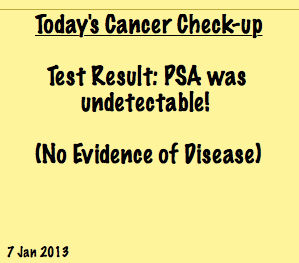
Upstairs, two weeks into the seventh year of my cancer journey, I report for my check-up; my PSA is once again undetectable. I remain no evidence of disease (NED). But my oncologist and I talk not about a cure but about how much longer I can go before my prostate cancer comes back. (I did, after all, have cancer in two lymph nodes at surgery.) He tosses out markers: another year, three years, five, and why each increment is better than the previous.
It was a hopeful discussion about an uncertain and unknowable future. Very much unlike my April 2012 check-up, which brought the despairing, hollowing out news of possible recurrence. With that came a sense of futility we cancerians know all too well: No matter what I do, I can’t get a break. It’s the point in your disease where you think you’ve hit bottom, and then someone shows you to a door leading down.
But today, my oncologist — who cautioned me a year ago not to read too much into those disappointing test results — actually sees me as NED since January of last year: Despite the scant and receding traces of PSA measured in April and July of 2012, I’m 15 months no evidence of disease.
From despair to hope — what a difference a year makes.
***
My visits to the cancer ward tend to be emotionally uneventful, but this time, I knew both despair and hope, raw and in full measure: despair that so many lives are marked by cancer; but hope that the wizardry of modern medicine can, if not save, at least meaningfully extend our lives. And that is why we were all there on the morning of Monday, April 8, 2013.
Each of us had an appointment with the doctors of hope, standing room only.